
Per Musicam Ad Astra
Origin
Empyrean, harmony between heaven and earth
Empyrean, the highest heaven of pure light, stands for a sphere beyond the visible world: for origin, understanding, creative energy, and that perfect harmony which humankind has sought for millennia in music, philosophy, science and art.
The name Empyrean Orchestra points to this long history. It joins one of the oldest ideas of Western culture with an experience that remains immediately comprehensible today: that music can carry us beyond the everyday.
Some masterworks do indeed seem to reach the very limits of human understanding. Their proportions, their inner logic and their emotional power can give the impression that they were less invented than discovered, as though the composer had, for a moment, gained access to an order that already existed.
This idea is very old.
Pythagoras: The Number behind the Sound
One of its origins leads to ancient Greece and to the school of Pythagoras in the sixth century BC.
According to Pythagorean tradition, musical consonance could be traced back to simple numerical ratios. The octave, the fifth and the fourth could be understood as proportions: 2:1, 3:2 and 4:3. This revealed something decisive: what the human ear perceives as harmony also possesses a mathematical structure.
For the Pythagoreans, this was more than music theory.
Number appeared as a principle underlying the visible world. If these same simple proportions produce beauty in sound, might similar ratios not also govern the order of the cosmos?
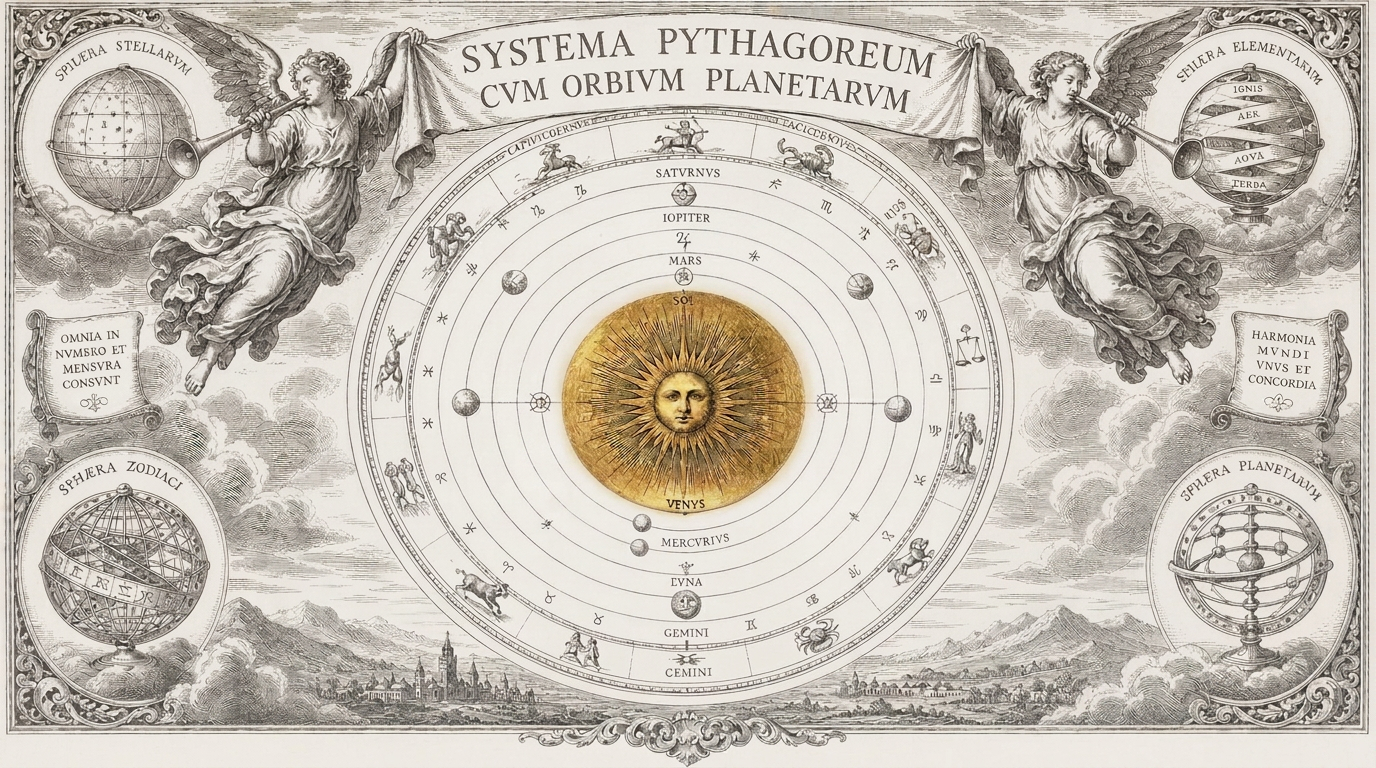
From this connection of number, sound and world arose the great idea of the harmony of the spheres, the Musica universalis.
The heavenly bodies, it followed, do not move chaotically, but within a perfect cosmic order. Their distances and motions correspond to harmonic ratios and together form a universal harmony.
The cosmos becomes an instrument.
The Music of the Spheres
In ancient and later medieval thought, music was therefore far more than what is merely heard.
It could be the expression of a fundamental order of the world.
The philosopher Boethius, in late antiquity, distinguished between musica instrumentalis, the music actually heard, musica humana, the harmony of body and soul, and musica mundana, the harmony of the cosmos.
Music thus united man and universe.
The harmony of an orchestra, the proportions of the human body and the movements of the stars could be thought of as different manifestations of the same principle.
The music of the spheres did not necessarily need to be audible to the ear. It denoted a deeper harmony, an order underlying all that exists.
In this thought, mathematics and mysticism meet.
This union of music, number and cosmos shaped European thought for centuries. In the medieval quadrivium, music stood alongside arithmetic, geometry and astronomy at the heart of higher learning. Music was thus regarded not merely as an art of sound, but as a way of perceiving proportion, harmony and the order of the world.
An Ordered Cosmos
For centuries, the heavens were imagined as a system of concentric spheres.
In the geocentric world view, the earth rested at the centre. Around it moved the Moon, Mercury, Venus, the Sun, Mars, Jupiter and Saturn. Above these lay the sphere of the fixed stars and further spheres enclosing the visible universe.
From today's astronomical viewpoint, this model is outdated. As a spiritual image, however, it possessed extraordinary power.
For the medieval cosmos was never merely an astronomical diagram. Distance also carried spiritual meaning. The ascent through the heavens could be understood as an approach to the divine.
Beyond the moving spheres, finally, began something that was no ordinary sphere at all:
the Empyrean.
Empyrean, the Heaven of Fire and Light
The word derives from the Greek empyros: "in fire", "fiery".
Yet the fire of the Empyrean is no destructive fire.
In philosophical and Christian tradition, it became the image of a perfect, immaterial light, a realm beyond change, time and bodily motion.
While the stars still circle and the spheres still turn, the Empyrean is unmoved.
It is not simply the most distant place in the universe. It stands outside the ordinary order of space altogether.
Here the idea of the cosmos reaches its metaphysical dimension: above the visible world lies not a further astronomical shell, but a reality of pure being and pure light.
The Empyrean was conceived as the dwelling place of God, the angels and the blessed.
Thus ancient cosmology unites with Christian theology.
Dante and the Empyrean
Scarcely any artist has given this vision more powerful form than Dante Alighieri in his Divina Commedia.
In the Paradiso, Dante ascends together with Beatrice through the celestial spheres. His journey passes through the spheres of the planets and the fixed stars to the Primum Mobile, the outermost moving sphere.
Yet beyond it lies the Empyrean.
Here space and time end.
Dante encounters no further mechanical celestial shell, but a world of light.
At first a river of radiant light appears to him, from which sparks break forth. These sparks become angels. At last the vision is transformed into the vast Candida Rosa, the white rose of Paradise, in whose countless tiers the blessed are gathered.
Light, motion, love and spiritual harmony become one.
The angels mediate between the divine origin and the created world. The nearer Dante draws to the highest principle, the less his experience can be described in ordinary images.
In the end, no astronomical explanation remains.
What remains is an experience of the infinite.
For Dante, the whole universe is ultimately moved by that power which "moves the sun and the other stars": divine love.
Angels and the Invisible Order
The idea of the angels, too, belongs to this cosmology.
In Christian tradition a complex hierarchy of heavenly beings developed. Especially influential was the teaching of Pseudo-Dionysius the Areopagite, who described nine choirs of angels: Angels, Archangels, Principalities, Powers, Virtues, Dominions, Thrones, Cherubim and Seraphim.
The term "choir" is remarkable in itself.
Heaven is imagined not merely as architecture but again and again in musical terms. Angels sing, offer praise and form choirs; harmony becomes the emblem of a perfect order in which multiplicity signifies not chaos, but unity.
The heavenly choir and the earthly ensemble mirror one another.
Many centuries of European music have been shaped by this idea.
Cosmology, Mysticism and the Occult
The idea of a hidden harmony was never confined to philosophy and theology alone.
In Neoplatonism, Hermeticism, alchemy, astrology and later esoteric traditions, one repeatedly encounters the thought that visible appearances express invisible relationships.
Planets were assigned to metals, colours, numbers, musical keys or qualities of the soul. Man appeared as a microcosm mirroring within himself the greater universe, the macrocosm.
Such systems do not belong to modern natural science. Historically, however, the boundaries between science, philosophy, religion, magic and art were far more porous than they are today.
Astronomy and astrology could coexist. Mathematics could be at once a practical science and a key to a metaphysical order. Music could be entertainment, mathematical discipline, religious service and cosmic symbol, all at once.
It was precisely in these transitional spaces that a great part of the European world of ideas developed.
Johannes Kepler: Harmony becomes Astronomy
One of the most fascinating figures in this history is Johannes Kepler.
In 1619 he published his Harmonices Mundi, the Harmony of the World.
Kepler already stood on the threshold of modern natural science and worked within the heliocentric model. Yet he held fast to the ancient conviction that the cosmos was structured by harmonic mathematical relationships.
He sought to understand the motions of the planets as musical intervals.
The ancient music of the spheres thereby acquired new meaning. It was no longer purely metaphysical speculation, but was now linked to mathematical observations of the actual movements of the planets.
From an ancient cosmic metaphor arose an impulse toward the mathematical description of nature.
This is one of the great ironies of the history of science:
An idea that may seem mystical to us today helped to formulate the questions from which modern science emerged.
Only with the modern era did music and natural science begin to develop increasingly as distinct disciplines. Yet their common language never entirely disappeared. In the works of Bach and Mozart we encounter proportion, symmetry and musical architecture at the highest level. At the same time, science too remained bound to sound: Galileo studied vibrations and musical intervals, while his father Vincenzo Galilei, as a music theorist, worked precisely at the intersection of sound, number and experiment.
From the Closed Heaven to the Infinite Universe
With Copernicus, Kepler, Galileo and Newton, the image of the cosmos changed fundamentally.
The earth lost its place at the centre. The crystalline celestial spheres vanished. The heavens opened onto an immeasurable universe, and the ancient search for its hidden order took on new forms.
Yet the Empyrean itself escapes such a change in the astronomical world view. As a reality beyond space and time, it does not belong among the things that can be charted on a map of the heavens.
The question remained:
Is there, behind the immense variety of appearances, a hidden order?
Beyond the Visible
Even modern physics today leads us to the limits of our conception of space, time and matter. In the quantum world, states can superpose, and particles separated in space can remain mysteriously connected to one another.
Something of that ancient idea inherent in the Empyrean resounds here: that the visible world may not be the whole of reality, and that beyond our immediate perception there exist connections that elude our familiar notions of nearness, distance and separateness.
Perhaps here, in new form, we encounter once again that ancient intuition that moved Pythagoras, Kepler and many others: that behind the visible lies a deeper order.
Sound as Physics
Today we know that sound is a physical phenomenon.
Vibration produces waves. Frequencies determine pitch. Overtones shape timbre. Resonance can couple complex systems to one another. Intervals can be described mathematically, and even the richest orchestral sounds arise from the superposition of vibrations.
Thus, on another level, something of the Pythagorean idea returns:
Sound is number in motion.
Yet music is at the same time far more than physics.
From frequencies arise expectation, memory, tension, motion and emotion. Neuroscience and psychology today investigate how our brains perceive rhythm, process harmony and remember musical form across long spans of time.
Between a vibrating string and the experience of a symphony lies an immense space.
It is precisely this space that fascinates us.
Listening to the Universe
Modern astronomy, too, is full of rhythms and vibrations.
Stars oscillate. Gravitational waves pass through space. Pulsars send signals with astonishing regularity. Scientists can translate measured data into audible frequency ranges, thereby making audible structures that would otherwise remain closed to our senses.
This does not mean that Pythagoras was right in a physical sense, and that the planets truly play a symphony audible to us.
Yet his intuition possesses a remarkable poetic relevance today:
The cosmos is full of periodicities, resonances, proportions and vibrations.
We have not found the music of the spheres as antiquity imagined it.
But we have discovered a universe that, in unexpected ways, is shaped even more strongly by rhythm and vibration.
The Empyrean in Art
The visual arts, too, have repeatedly sought to make the invisible visible.
Medieval and early modern artists depicted the heavens as a concentric order; gold ground became the sign of a light originating from no earthly source. Angels, celestial spheres and heavenly choirs populate manuscripts, frescoes, altarpieces and cosmological diagrams.
In Hieronymus Bosch, the world beyond becomes an enigmatic visionary realm. William Blake fuses poetry, mysticism and image into a personal cosmology. In his famous illustration "L'Empyrée" for the thirty-first canto of Dante's Paradiso, Gustave Doré transforms the Empyrean into a monumental vision of light, angels and circling movement.
And even beyond expressly religious art, the longing to make the invisible visible persists: in William Turner's dissolving light, in Wassily Kandinsky's search for a spiritual effect of colour and form, or in abstract art that translates rhythm, proportion and sound into visual structures.
Painting and music touch one another where both attempt to express what eludes language.
Prometheus and the Creative Fire
For the Empyrean Orchestra, fire holds a further meaning still.
It recalls Prometheus, who stole fire from the gods and brought it to mankind.
This fire stands for understanding, craft, creative power and the human will to transcend limits. It can warm and illuminate, but it can also become dangerous. It is precisely this ambivalence that makes Prometheus one of the most powerful figures in European cultural history.
The Promethean fire and the light of the Empyrean do not belong to the same mythological tradition.
For us, however, they meet in a single shared image:
the creative spark.
The moment in which sound arises out of silence, a score arises out of an idea, and a shared musical organism arises out of many individual human beings.
What Does Empyrean Mean Today?
Perhaps the Empyrean is that which sustains all becoming, and itself does not become.
Our conceptions of the cosmos have since changed many times, from the circling spheres of antiquity to the infinite universe of modern astronomy. Pythagoras sought in number and sound a hidden harmony of the universe. Dante saw, beyond the circling heavens, a realm of pure light. Kepler sought, in the motions of the stars, the order that binds music and cosmos together.
Today we can look immeasurably further into the universe, measure vibrations, describe the motions of the heavenly bodies with astonishing precision, and register phenomena invisible to earlier generations. Yet every new insight opens new questions in turn. What we can observe and measure need not be the totality of what exists.
Perhaps this is precisely where the enduring power of the Empyrean lies. For Dante's Empyrean was never simply a distant place at the outermost edge of the universe. It lies beyond space and time, and thus, by its very nature, eludes a purely spatial conception. No telescope could ever locate such a place, just as no astronomical chart could confirm or refute its existence.
The Empyrean can therefore still stand today for the possibility that, behind the visible and measurable world, a deeper reality lies, an order whose nature we may sense without ever fully grasping it.
Music leads, in its own peculiar way, to this very boundary. We can measure frequencies, analyse vibrations and describe harmonic relationships mathematically. Yet the mystery of music is not thereby exhausted. What happens when sound becomes meaning, when a harmony touches us in our innermost being, or when a musical moment gives rise to the feeling of stepping, for an instant, beyond ourselves?
Perhaps Pythagoras's harmony of the spheres, Dante's Empyrean and our own present search for the hidden structures of the universe have more in common than they at first appear to. They spring from the same human longing: to perceive coherence behind appearances, and to draw closer to that which is greater than ourselves.
The Empyrean remains, in this sense, an image of the immeasurable, of light, and of a perfect harmony that eludes our complete understanding.
Within the Empyrean lies, at the same time, a cipher for transcendence, for the human longing to sense the invisible and to touch the immeasurable.
Empyrean Orchestra
An orchestra is itself a small universe.
A collective in which every voice remains true to itself and yet is absorbed into something greater, something none of them could bring forth alone.
From that ancient search for number and harmony to the modern exploration of sound and cosmos, a single thought runs through more than two thousand years:
Music is a search for order within the immeasurable.
For us, Empyrean denotes this imagined horizon, the place where science and art, reason and emotion, earthly craft and boundless imagination meet one another.
Toward that horizon our musical search is directed.
Per Musicam Ad Astra.
Through music to the stars.